01 / DYNAMIC TOPOLOGY
Connections keep changing
Mobility, terrain masking and node loss change which multi-hop routes are available. Engineers need visibility into how the network reforms and recovers.
Wireless networks change as platforms move, links are obstructed and interference appears. Testing a single radio pair cannot reveal the behavior of an entire adaptive mesh. Recreating large, mobile field scenarios for every software change is costly and difficult to repeat.
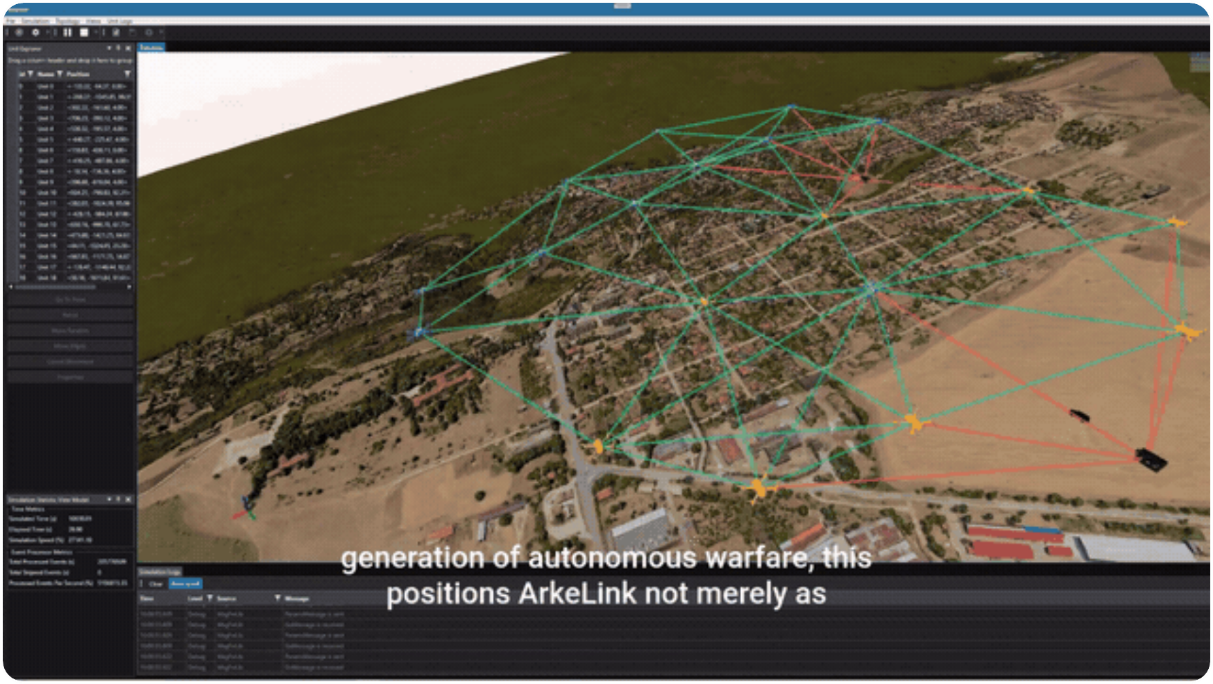
In a distributed mobile network, every unit can alter connectivity for other units. A route that works in a controlled bench test may behave differently when nodes move, radio conditions degrade or traffic changes. This calls for testing the complete protocol stack in a scenario that can be reproduced.
Mobility, terrain masking and node loss change which multi-hop routes are available. Engineers need visibility into how the network reforms and recovers.
Propagation, interference, transmissions and collisions influence the waveform and traffic carried through the mesh. Arke Telekom’s original access architecture also coordinates TDMA timing, hopping-based FDMA capabilities and code-based CDMA access; these interactions need to be examined together, not as isolated radio links.
Field trials with many moving nodes are expensive and difficult to reproduce exactly. Software changes need comparable conditions and traceable outcomes.
Digital twins provide a way to exercise the waveform with virtual nodes, modeled channels and mobility before all hardware is available. Teams can inspect behavior, preserve logs and repeat a scenario to understand what changed.
The same closed-loop method can begin during initial product design, when a customer requirement introduces a new capability, or after field observations reveal behavior that must be reproduced and improved. The full lifecycle is shown on the What is ArkeSim? page.
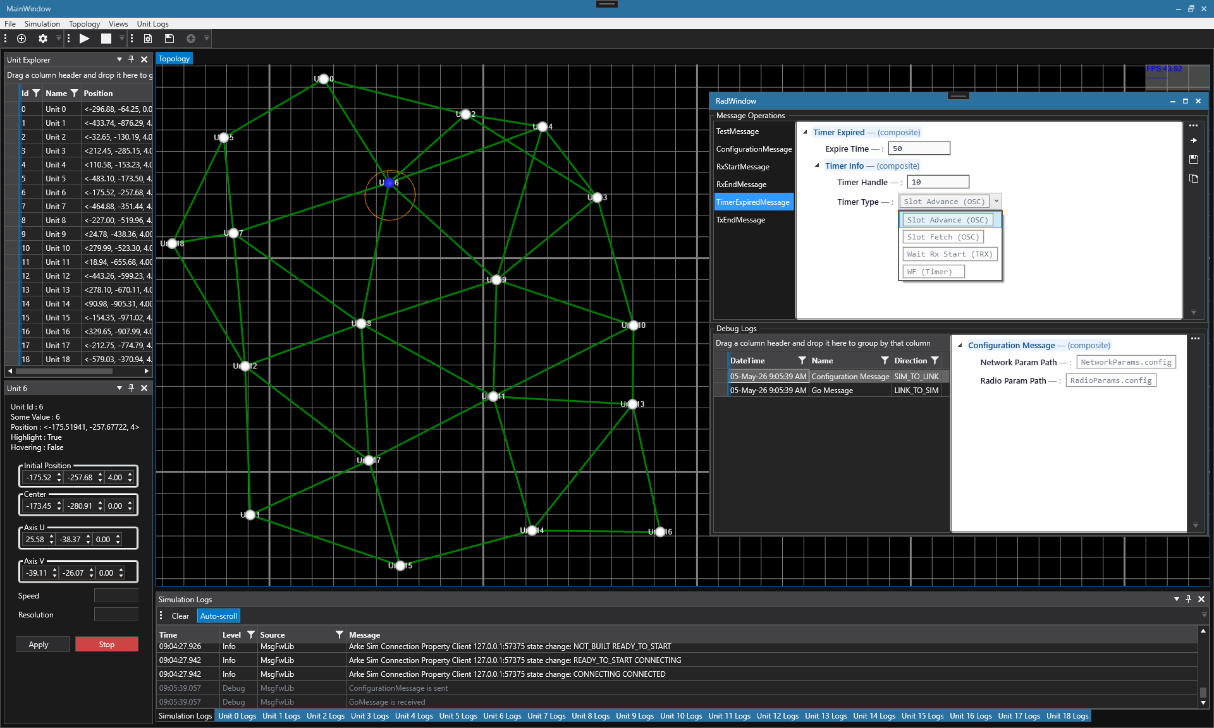 Actual ArkeSim network visualization
ArkeSim was developed to run waveform and network software inside emulated conditions — and make network behavior observable, logged and repeatable.
Explore the ArkeSim platform and discuss how digital twins can support waveform development.